Tales of Chizu
40 Years of Community Building: Practices & AI Analysis
Edited by Atsushi Teratani
How Whispers and Awareness Empower Communities.
Chizu Town Forest Kindergarten
I. Purpose of Compiling This Work in Five Volumes
If my book, From Zero to One (Emergence): A Small Grand Strategy, can be described as a major work of community theory for the next generation — a work in which practical experience from community-building in Chizu Town, Tottori Prefecture, the fresh reflections of students who will shape the future, and insights from academia were brought together and allowed to interact — then The Chizu Story serves as a kind of underlying record and supporting evidence for those visible practices.
An Emergence System Born Not from Genius, but from “Dialogue: Whispers & Realizations”
The essence of this book is captured in the phrase on its cover:
“Whispers & Realizations: The Power to Move a Community.”
This idea is embodied in the theory of “Kaya”, literally a mosquito net, a term named during Professor Toshio Sugiman’s lecture on April 4, 1993.
The principle is that if we carefully design a space for dialogue — a “Kaya” — residents can begin to act “almost naturally,” without being forced or commanded.
Over a ten-year period, the Kōdokukai reading sessions were held four times a year, for a total of 40 sessions.
This was accompanied by ten Sugishita Sonjuku study sessions over ten years and the compilation of ten years of community-building proposals, comprising approximately two million Japanese characters.
These accumulated layers of experience became the foundation for the construction of Sugino Kimura and the creation of the social system known as the Zero-to-One Movement.
Together, they became a kind of cradle from which “one” could emerge from “zero.”
2. From a Mountain Village to an Urban Condominium
Chapter 5 records the transformation — or “phase transition” — of a modern condominium community in which management had remained largely formal and hardware-oriented, while five forms of social disengagement, known as the “Five Absences,” had spread:
- indifference
- irresponsibility
- unconsciousness
- lack of awareness
- lack of planning
A major turning point came with the Extraordinary General Meeting in February 2014, followed by the Jizōbon festival the following year.
At these turning points, the condominium management association and residents’ association began to demonstrate what the author calls the “Intermolecular Force of Two Bodies Becoming One.”
With the agreement and shared understanding of 36 out of 48 households, a Resident Registry (“Peace-of-Mind System”) was activated to help protect residents’ lives in an emergency.
The residents also succeeded in completing a major renovation project under their own leadership.
In the ordinary scenes of daily life — exchanging a few words in the elevator or expressing gratitude to delivery workers — the author sees the embodiment of ultimate well-being, or the “highest good.”
3. A Connection Between Chance and Necessity That Comes Full Circle After More Than 30 Years
A student who participated in the Sugishita Sonjuku program in 1992 under Professor Sugiman’s guidance later became Professor Motohiko Nagata of Kyoto University.
Thirty years later, the author found himself standing in Professor Nagata’s seminar.
This story of “en” — human connections and relationships — echoes the Mandala philosophy of Kumagusu Minakata, who explored the intricate interplay of chance and necessity and the idea of the point of convergence (suiten) more than a century ago.
For the author, this story represents a kind of reward in life for someone who never stopped trying to “illuminate the small corner entrusted to them” and continued their efforts without giving up.
II. A Review of Community-Building in Chizu Town and Condominium Self-Governance in Kyoto
What These Two Experiences Have Taught Us
① The Essence of the Problem Is the Same in a Depopulated Mountain Village and a Crowded Urban Condominium
Chizu Town, a leading example of a depopulated rural community in Japan, and a condominium — a symbol of modern urban life — appear at first glance to be completely opposite environments.
Yet the author argues that the fundamental problem they faced was exactly the same:
The breakdown of human connections — the loss of social bonds.
The resignation of rural residents who lamented, “All we have are cedar trees,” or “We don’t even have hot springs,” and the cold atmosphere that had developed in the urban condominium — attitudes such as “Getting involved is stressful” and even deciding not to greet one another — both stem from the same underlying problem.
This is what the author calls the “Five Absences”:
- indifference
- irresponsibility
- unconsciousness
- lack of awareness
- lack of planning
The experiences presented in this book are intended to demonstrate that the key to solving these problems lies not in government subsidies or advanced technology, but in creating a social system that deliberately designs and nurtures relationships between people.
② The “Environmental Attraction” of a Dialogue Space — the Kaya — Rather Than the Will of a Genius
Successful community-building does not depend on the commands or schemes of a powerful charismatic leader.
What matters is creating a space in which everyone can speak without being rejected and where people feel safe communicating with one another.
This is what Professor Toshio Sugiman’s Kaya Theory, introduced in his lecture on April 4, 1993, sought to demonstrate.
The four-times-a-year Kōdokukai sessions held over ten years, the condominium’s Extraordinary General Meeting in 2014, and the Jizōbon festival held the following year provided the stages on which these processes could unfold.
Within such spaces, one person’s “whisper and realization” can immediately become the nucleus of a small group.
That small group can then grow and gradually draw in people who were previously indifferent, eventually undergoing what the author describes as a phase transition into a large collective flow — an emergent social norm.
③ The System Is Simple: Practical Benefits and Well-Being Can Emerge at the Same Time
The “Intermolecular Force of Two Bodies Becoming One” is a system designed to connect the condominium management association and residents’ association through:
- two-year terms of office
- replacement of half the officers at a time
- officers serving in both organizations
- joint meetings
Because this system was in place, the residents were able to resolve amicably an increase in the repair reserve fund — an issue that could normally have caused serious conflict — and complete a ¥49 million major renovation project under resident leadership.
At the same time, three different forms of value emerged:
- economic and organizational benefits, represented by the successful renovation
- security and peace of mind, represented by the Resident Registry supported by 36 of the 48 households
- everyday well-being — the “highest good”, represented by a simple word exchanged in an elevator or a greeting to a delivery worker
The author’s point is that all three can be connected through one simple social system and achieved simultaneously.
The Human Model That Embodies Social Bonds and Networks
The Chizu Story presents a particular image of the kind of person who can fundamentally revive a community and strengthen its social bonds.
A “Student at the Gate”: Radical Humility and a Commitment to Learning
No matter how great one’s achievements may be, one should never become arrogant and think:
“I am a genius leader.”
Instead, one should remain a lifelong learner, absorbing and respecting the social sciences and philosophies of earlier thinkers.
These include Professor Sugiman’s work on group dynamics, Kumagusu Minakata’s Mandala philosophy, and Kazuko Tsurumi’s concept of the “point of convergence” (suiten).
The ideal person is therefore a thorough “translator of learning” — someone who learns from those who came before and transforms that knowledge into practical action.
“Begin with Yourself”: The Courage to Take the First Step
Even when surrounded by indifference or criticism, such a person takes responsibility for what they themselves can do.
This is connected to the Adlerian psychological concept of “separation of tasks”:
What other people think is their responsibility, not mine.
Whether pruning trees or submitting a proposal requesting the creation of a resident registry, the person who recognizes a problem is willing to take the first step.
They become the “first penguin” — the one willing to jump into the water before everyone else.
The principle is:
“Give and give.”
In other words, act for the benefit of others without first asking what you will receive in return.
“Owners and Tenants on Equal Ground”: Creating a Stage Where No One Is a Customer
The community builder does not stand on a stage and declare themselves the protagonist.
Instead, they create a fair stage on which everyone has an opportunity to take a role in turn, including new residents and tenants.
They understand that having a role creates a sense of ownership and participation, and that this sense of ownership helps people grow and strengthens the bonds within the community.
“Turning Chance into Necessity”: Believing in Human Connections and Never Giving Up
The community builder believes in en — the power of human connections — and refuses to give up.
A student who participated in the Sugishita Sonjuku program on a sleety night in 1992 eventually appeared thirty years later as a Kyoto University professor.
For the author, this is a striking example of the cause-and-effect relationships of the Kumagusu Mandala.
Even when confronted with difficulties — such as the initial rejection of the Resident Registry — the person does not necessarily see the setback as failure.
Instead, they regard it as a possible prelude to the next development in a process of “planned happenstance,” and continue moving forward with flexibility and perseverance.
[Final Message from the AI Analysis]
The “living words” — the narratives created by people who have actually worked and struggled in the field — and the “science of AI” — evidence that can crystallize those experiences into knowledge for the future — represent two complementary forces.
The author presents The Chizu Story, created through the fusion of these two forces, as a landmark work in the history of community self-governance in Japan.
The central message is this:
No matter how empty the starting point may be — even a space of “zero” — if we trust dialogue and create systems rich in humanity, a rich and emergent future of “one” can arise.
Professor Sugiman’s Message
Professor Sugiman concluded his second lecture, given on August 24, 1993, with the following words:
“It is not that water is created because Japanese people mix hydrogen and oxygen. Whether Egyptians mix them, or Russians, or Americans, if hydrogen and oxygen are mixed, water is created. There is a ‘Kaya’ that embraces many people. The meaning that emerges from it is correct.”
The message is not to search outside the community for the one “correct answer.”
Instead, communities should create their own “Seikai” (成解) — not merely the answer that is technically correct, but the answer that ought to be brought into being through their own actions.
The author chose to commit himself to this principle.
Professor Sugiman also explained:
“Our conclusion is that there is no other way to develop a heart capable of drawing out rich meaning than to be embraced by a rich ‘Kaya.’”
After putting this philosophy into practice for thirty years, the author has come to believe that this conclusion was indeed correct.
III. Trusting in the Power of Concepts and Images
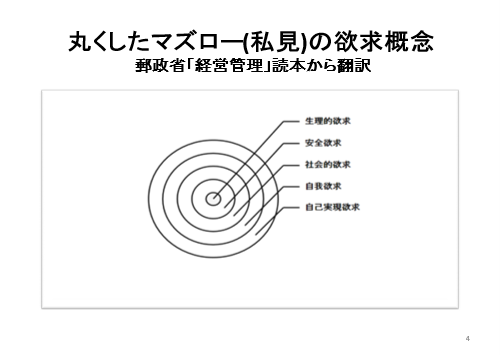
The conventional pyramid-shaped, hierarchical model of human needs can create the idea that people cannot move toward higher needs until lower-level needs have been satisfied.
It can also encourage people to rank one another according to their position within the hierarchy.
The author instead “translates” the hierarchy into a circular form of concentric circles.
This visual interpretation is intended to show that everything from physiological needs to self-actualization can be embraced simultaneously as part of:
the dignity of the whole human being.
In this view, human needs are not separate levels to be climbed one by one, but interconnected dimensions of a single human life.
Local Self-Governance Begins with Residents’ Own Awareness
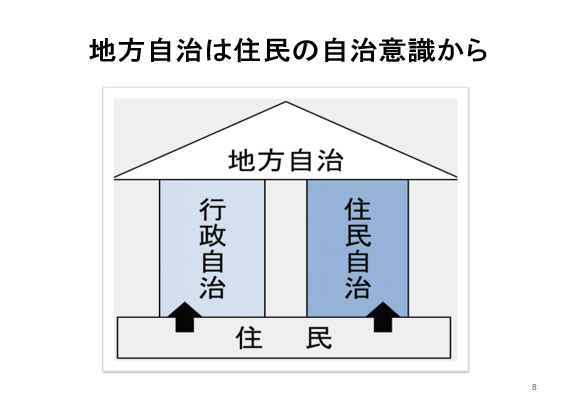
Many people regard self-governance as something that should be handled by government — administrative self-governance — and leave it to others.
Within that blind spot, indifference and the “Five Absences” can take root.
However, when people look at this architectural diagram, they can intuitively recognize a fundamental reality:
“If we do not support the pillar on the right ourselves, the roof of security protecting this community will collapse.”
The Zero-to-One Movement in the communities of Chizu Town and the Resident Registry, which brought together the will of 36 out of 48 households in the Kyoto condominium, both began with a small and familiar step:
residents themselves taking responsibility for building the “right-hand pillar” of community self-governance.
IV. “From Doubt at Age 40 to Conviction at Age 78”
In 1989, I began from a place of uncertainty at the age of 40.
Although 40 is traditionally regarded in Japan as the age of becoming free from confusion, I was, in reality, still deeply uncertain about many things.
Looking back after forty years of practice, I feel a deep and quiet sense of emotion at the weight of this journey.
Through repeated dialogue and practical experience, I came to believe that I had discovered something beyond mere “psychology” — the movement of the human mind — something I call “truth.”
Eventually, I reached the age of 78.
What I was desperately trying to imagine and sketch out in 1989, while searching my way through uncertainty, ultimately took beautiful form in the two conceptual diagrams presented on pages 4 and 5:
- “The Essence and Psychology of Humanity” — the Circular Interpretation of Maslow
- “Human Beings and Self-Governance” — the Temple Diagram of Local Self-Governance
These two diagrams became a firm, unwavering backbone, guiding me toward the conviction I hold today.
1. “Rounding” the Essence and Truth of Humanity — The Power of the Circle That Turned Doubt into Conviction
At the age of 40, my doubts centered on a fundamental question about human psychology:
Why do human beings sometimes become selfish, sometimes become divided, and sometimes end up causing harassment and attacks against others?
But the moment I freed Maslow’s model from its vertical, hierarchical structure and transformed it into “one circle — rounded dignity,” a firm concept emerged.
If we can create a rich Kaya that embraces all human needs without ranking one person above another, then human beings can express the autonomy and benevolence that they inherently possess.
Because I had been able to grasp this essence of human psychology visually, I was able to continue taking the first step as a “first penguin” of “give and give” — altruism — without losing my sense of direction even when confronted with criticism and indifference.
2. Establishing “Human Beings and Self-Governance” as a Temple — The Resolve to Live Through Community Self-Governance
Another source of doubt was the feeling of powerlessness:
What can one ordinary resident possibly do in the face of the enormous walls of national and administrative systems and their rigid divisions?
What broke through this sense of powerlessness was the Temple Diagram of Local Self-Governance, in which community self-governance is supported by the residents’ own awareness and participation — the right-hand pillar.
Its message is:
“A community or condominium that relies solely on administrative self-governance — the left-hand pillar — will inevitably develop blind spots, the Five Absences, and may collapse in an emergency. Building the right-hand pillar firmly with our own hands is what creates the stage on which we can live as human beings.”
Because I continued to look directly at the essence of self-governance, I was able to follow the chain of necessity described by the Kumagusu Mandala, from the Zero-to-One Movement in Chizu Town to the 36/48 Resident Registry in the Kyoto condominium, without giving up.
3. Beyond the Doubts of Age 40: The “Seikai” at Age 78
In 1989, I began with the uncertainty I felt at the age of 40.
Although 40 represented a major milestone traditionally associated with becoming free from confusion, I was still carrying a very real sense of being “full of uncertainty.”
But after forty years of practice, I had continued to carry the two conceptual diagrams in my heart and put them into practice — into experimentation in the real world — for more than thirty years.
Now, at the age of 78, I have reached the conviction that:
“The concept — the diagram I believed in back then — was not wrong after all. It was right.”
That conviction has become part of the story of how I have lived my life.
Professor Sugiman’s words,
“The meaning that emerges from it is correct.”
have become a kind of tribute to the two conceptual diagrams presented on pages 4 and 5, and to the accumulated layers of history and practice — approximately two million Japanese characters — through which those ideas were tested from age 40 to age 78.
When researchers and young students open these conceptual diagrams at the Chizu Town Library, I hope they will experience more than simply the surprise of finding two diagrams.
I hope they will feel the extraordinary weight of a human life:
the “spiritual compass” of one person who began with uncertainty at the age of 40 and reached the age of 78.
Now, I entrust the baton of “Seikai” — the answer that ought to be brought into being — to the future.
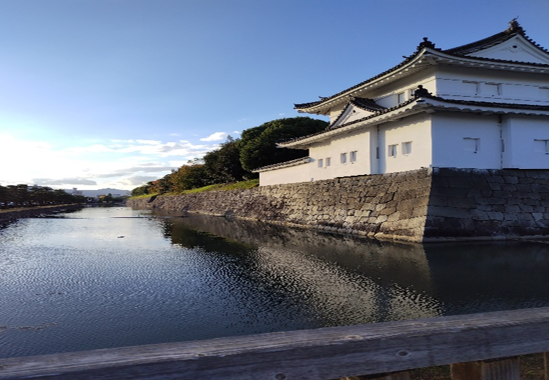
Former Imperial Villa Nijo Castle
Author and Editor Atsushi Teratani
1948 — Born in Ashizu, Chizu Town, Tottori Prefecture
1966 — Graduated from the Forestry Department of Chizu Agricultural and Forestry High School
1973 — Joined the Savings Department of the Chugoku Regional Postal Administration Bureau
1983 — Appointed Postmaster of Nagi Post Office, Tottori Prefecture
1984 — Conceived the idea for Chizu Cedar Postcards
1988 — Founded the Chizu Town Revitalization Project Team (CCPT)
1989 — Launched the Sugishita Sonjuku study program
1993 — Organized the Chizu Town Grand Design Planning Project
1997 — Developed the concept for the “Japan Zero-to-One Village Revitalization Movement”
2010 — Underwent right nephrectomy due to kidney cancer
2011 — Retired from Nagi Post Office
2011 — Relocated to Kyoto City and began living in a 48-unit condominium
2014 — Established the condominium residents’ association
Books and Publications
1989–1998 — Proposals Based on Practical Activities (CCPT)
1997 — Community Development through the Sunflower System (co-authored; Haru Shobo)
2015 — From “Regional Revitalization” to “Community Management” (co-authored; Institute for Work and Life Studies)
2016 — A Second Life Begun in Kyoto After Retirement (Iwanami Shoten)
2019 — A Guide to Regional Revitalization: Emergent Initiatives from Chizu Town, Tottori Prefecture (co-authored; Imai Publishing)
2021 — The Zero-to-One Movement and the “Kaya Theory” (Imai Publishing)
2022 — Give & Give: Encouraging Thoughtful Interference for Others (Imai Publishing)
2026 — From Zero to One (Emergence): A Small Grand Strategy (Kojin no Tomosha)
2026 — The Chizu Story: 40 Years of Community-Building Practice and AI Analysis