AI Analysis: The Meaning and Value of “Connecting” — Emergent Practices
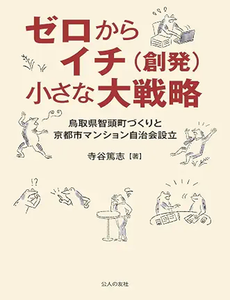
Background: From Zero to One (Emergence): A Small Grand Strategy — Practical Applications
Edited by Atsushi Teratani

I. Motivation for Building a Community and Its Social Background
1-1. October 2011: A Sense of Crisis upon Moving into a Condominium in Kyoto City
In October 2011, I left the mountain village of Chizu Town in Tottori Prefecture, where I had lived for many years, and moved into a condominium in Kyoto City. This marked the beginning of an experimental effort to create a new local social system for the second stage of my life.
What I witnessed at the time was a deeply troubling reality in urban condominium living: a social space that was virtually a “zero.” Most residents were completely indifferent to condominium disaster preparedness, and it was commonplace for people not even to know who lived next door. Although a condominium management association existed, its activities were confined largely to the formal management of the building’s physical infrastructure and the maintenance of property values. It had no organic channels of cooperation with the neighborhood association in the local school district or with the wider community rooted in local relationships.
The starting point for this initiative was a profound sense of crisis at the overwhelming fragility of these nonphysical, social aspects of community life.
1-2. The Structure of “Isolation” and Indifference in Modern Urban Society
Today’s urban social environment is experiencing a serious breakdown of human bonds. Family relationships are becoming weaker, local shopping streets are declining, and ties rooted in local communities are disappearing.
In some condominiums, the situation had reached the point where residents formally proposed and passed rules at general meetings prohibiting greetings in places such as entrance halls, supposedly to prevent interpersonal trouble.
People came to regard relationships with others as “a nuisance” or “a source of stress” and deliberately chose to avoid interaction. Five forms of “non-engagement” became widespread: indifference, irresponsibility, unconsciousness, lack of awareness, and lack of planning.
Yet Japan had clearly entered a period of heightened seismic activity. It was evident that no matter how robust a building’s physical structure might be, a breakdown in its social fabric could lead to devastating losses during a disaster, including solitary deaths, delayed evacuations, and the collapse of mutual assistance.
1-3. “Family Ties May Be Distant, but Local Ties Are Close and Reassuring”: Practicing Altruism
In an emergency, relatives who live far away cannot necessarily rush to help. The people who can save lives and protect our everyday sense of security are those physically closest to us: the people connected to us through our local community.
Whether in a mountain village suffering from extreme depopulation or a modern condominium where people are surrounded by crowds yet sink into loneliness, the fundamental nature of the social system is the same.
What was needed was for someone to take the first step and practice “Give and Give,” contributing to the community without expecting anything in return.
I began the challenge of creating community strength from zero, guided by the resolve expressed in the saying, “A nail that sticks out gets hammered down, but one that sticks out too far does not. A nail that is never hammered down, however, is useless.” I was also guided by a principle from Adlerian psychology known as the “separation of tasks”: what other people think is their concern; my responsibility is to do what I believe is right.
II. The “Strategy of Lines” and the “Strategy of Surfaces”: Transforming a Condominium into a “Horizontal Society”
2-1. The Strategy of Lines: Deliberately Weaving Human Relationships
To transform a condominium—a vertically stacked structure—into a living human community rather than a mere mass of concrete, I devised a strategy that began by drawing “lines” between people.
The deliberate process of weaving human relationships together consisted of three interconnected approaches.
- Creating horizontal lines: Bonds within each floor. To strengthen connections among residents living on the same floor, I proposed establishing a system in which each floor would have a designated “community coordinator.” This would support informal, everyday mutual watchfulness and ensure that communication took place at the smallest unit of the condominium community.
- Creating diagonal lines: Activities connecting generations. To create opportunities for children and adults to interact as equals, I organized hands-on events for children in the condominium, including making sweets, baking bread, and preparing daifuku, a traditional Japanese confection made with mochi. These activities naturally fostered relationships that crossed generational boundaries.
- Creating multiple lines: Layering local seasonal events. Rather than allowing activities to end as one-off events, I incorporated recurring seasonal celebrations into an annual program, including Jizō Bon, a traditional local Buddhist festival for children; Christmas parties; and Halloween events. These overlapping lines of interaction deepened and strengthened relationships among residents.
2-2. The Strategy of Surfaces: Organic Cooperation with the Local School-District Neighborhood Association and External Systems
When lines overlap, they eventually form a surface.
I therefore pursued a “strategy of surfaces” that went beyond establishing a residents’ association within the condominium. The aim was to connect it organically with the local Demizu School District Neighborhood Association and the voluntary disaster-prevention organization.
The condominium had strong physical infrastructure but weak social connections. By contrast, the local neighborhood association possessed longstanding social ties rooted in the community’s history but lacked robust physical facilities that could serve as disaster-prevention hubs.
By complementing one another’s strengths and weaknesses, these two systems could establish a network of safety and security that encompassed the entire community.
III. Strategies for Cooperation Between the Management Association and the Residents’ Association: The Journey from Hop to Step to Jump
3-1. “Hop”: Recognizing Problems and Starting with What Can Be Done (2012 Onward)
In July 2012, I became a member of the condominium management association’s board through a rotating appointment system. I viewed this as an excellent opportunity—a stage on which to act—and began by making concrete improvements rather than trying to persuade people through words alone.
First, I proposed that the board formally appoint a designated fire-safety officer to prepare for emergencies and ensure that the officer received the necessary training. The proposal was approved.
Next, I identified a safety hazard caused by poor visibility where the east staircase at the entrance intersected with the pedestrian walkway and took steps to address it.
I also proposed improving the living environment and making the shared spaces more open by trimming the ornamental trees, and I began carrying out the work myself.
Furthermore, to reduce electricity consumption in common areas, I proposed fine-tuning the sensitivity and timing settings of lighting sensors and relocating the sensors themselves. These measures produced tangible cost savings for the management association.
Through these visible, practical improvements, I gradually earned the trust of residents and fellow board members.
3-2. “Step”: Making Small Changes to the Social System (2014 Onward)
In February 2014, an extraordinary general meeting was held, and the condominium residents’ association was finally established as an official organization.
This meant that, alongside the existing management association responsible for maintaining the building, a new system of residential self-governance had been created to protect residents’ everyday lives and safety.
The most important challenge was designing a social system that would prevent the two organizations from becoming disconnected. Specifically:
- The term of office for management association board members was extended from one year to two years, with half the members replaced each year to ensure continuity in operations.
- A rule was established requiring at least one management association board member to serve concurrently as an officer of the residents’ association.
- A system was established for holding joint meetings of the management association board and the residents’ association officers.
As a result, the physical and social dimensions of condominium life began to function together like two inseparable entities, connected by an intermolecular force.
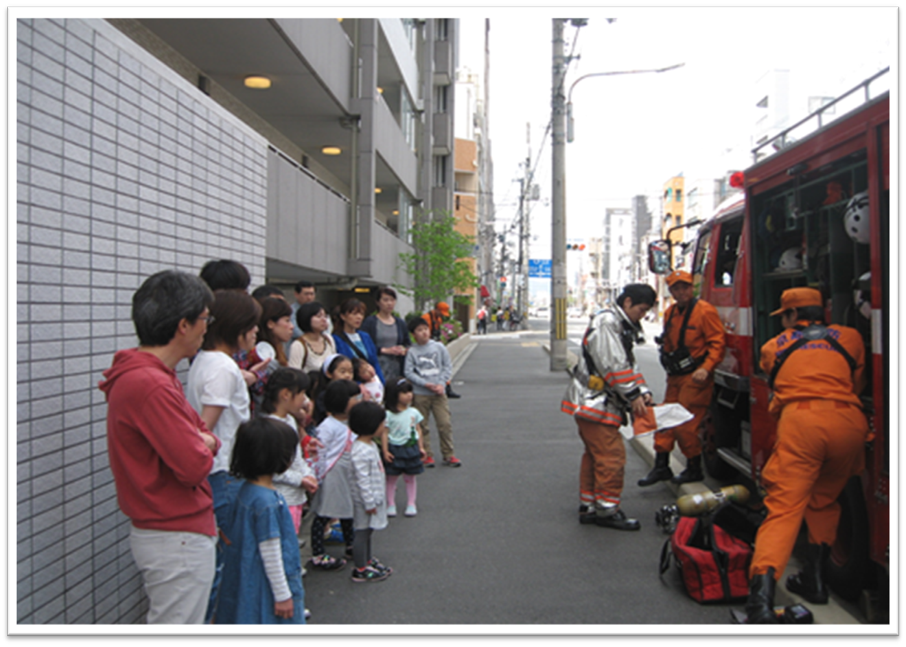
In April of the same year, the condominium conducted its first full-scale fire drill. In conjunction with the drill, a survey of all residents’ family circumstances was carried out.
In July, the management association’s general meeting officially approved an annual subsidy of ¥50,000 for the residents’ association. A disaster-prevention and disaster-mitigation lecture was also held, featuring Professor Norio Okada, Professor Emeritus of Kyoto University. At the event, an innovative concept was proposed: using the entrance hall as a central hub for disaster preparedness.
IV. Deepening the Practice and Creating a “System of Security” Through a Resident Registry
4-1. “Jump No. 1”: Addressing Fundamental Challenges and Demonstrating Tangible Benefits (2015–2024)
Following the establishment of the residents’ association, residents’ awareness of self-governance was steadily cultivated through activities such as Jizō Bon celebrations, Christmas parties, and workshops held in collaboration with Kyoto University’s Summer Design School.
The greatest test of this growing sense of community came with the large-scale renovation project that began in 2019.
Large-scale renovation projects involve substantial sums of money and are often left largely to the management company. However, the sense of shared responsibility fostered through the residents’ association’s activities encouraged three residents to volunteer as members of a renovation committee.
At the 2019 general meeting, the proposal was approved with the agreement of all concerned. Following a rigorous bidding process involving three companies, the residents successfully completed a major renovation project between March and June 2023, taking the lead themselves. The total cost was ¥49 million, including ¥1.6 million in management-related fees.
This was a tangible example of the economic and organizational emergence made possible by the intermolecular force connecting the physical and social dimensions of the condominium as an inseparable whole.
4-2. The Rationale for Creating a Resident Registry and the Process of Turning an Initial Rejection into a Breakthrough
Alongside the renovation project, I undertook what proved to be the most difficult challenge: creating an “Emergency Resident Registry.”
With growing concerns about the risk of a major Nankai Trough earthquake and earthquakes caused by major active faults in Kyoto City, including the Hanaore Fault, it was absolutely essential to understand residents’ circumstances in advance. In an emergency occurring at night or on a holiday, for example, it might be impossible to contact the management company. Information about residents’ situations—including whether they were elderly, whether they had underlying medical conditions, and whom to contact in an emergency—could therefore be crucial.
However, when the proposal was first presented at the July 2022 general meeting, concerns about personal information protection and the feeling that “getting involved would only create more trouble” led to its rejection. The proposal failed to secure a majority of votes, and the decision was made not to create the registry.
Distressed that the proposal had been rejected without a shared understanding of its fundamental purpose—protecting lives—Teratani resolved to challenge what he considered a reversal of priorities. Although 36 of the condominium’s 48 households supported the proposal, it had still been rejected under the voting rules. In response to a request from the officers’ meeting, he submitted a written appeal.
At joint meetings of the management association and the residents’ association, Kichiro Seki, who was responsible for disaster preparedness within the residents’ association, continued to explain and share the genuine intentions and objectives behind the proposed registry.
In July 2023, an incident at a condominium in the nearby Fushimi Ward provided an important lesson. Smoke from electrical transformer equipment caused a power outage affecting 650 households. During the height of summer, residents were unable to use their air conditioners and were forced to evacuate.
This incident demonstrated that disasters are not limited to natural events. They can also arise from gaps and vulnerabilities in the systems on which everyday life depends. Awareness of this broader understanding of disaster risk began to spread among residents.
4-3. January 2024: The “System of Security” Becomes Fully Operational Through Voluntary Submission
Through sustained dialogue and the sharing of a common purpose, the creation and operation of the resident registry were finally approved at the second board meeting of the condominium’s 13th term, held on November 25, 2023.
The system was remarkably simple and rational.
The registry would be submitted voluntarily by residents who agreed with the principles of mutual assistance and altruism. The information requested would be limited to four items: family composition, number of residents in the household, whether anyone had an underlying medical condition, and emergency contact information.
Its most distinctive feature was that every person who submitted a registry would receive a booklet containing the information, which they would keep themselves. In other words, it would function like a mutual contact directory shared among participating residents.
Rather than becoming dormant data stored in the management office, the registry created a living network of security in which residents could contact one another directly during an emergency.
On January 31, 2024, the registry was distributed to the 24 households that had consented to participate. The condominium’s “system of security” had now become operational in both name and reality.
The condominium’s appropriate management practices were also recognized. On December 26, 2024, it achieved a high rating of four stars, with a score of 81 points, under Japan’s Condominium Management Evaluation System.
V. Ongoing Emergence and the Future of Urban Communities: Jump No. 2
5-1. From July 2025: New Developments in the Residents’ Association and the Creation of Sustainable Operating Funds
The residents’ association created its own financial foundation—a social system designed to sustain its activities over the long term.
By combining income from one parking space (¥21,000 per month × 12 months = ¥252,000), electricity savings (¥6,000 per month × 12 months = ¥72,000), and annual savings on tree-pruning costs (¥60,000), it established a business model that generated ¥384,000 in independent operating funds each year.
This made it possible to run a full annual program reliably without collecting additional membership fees from residents. The program included a fire drill in May, a general meeting in July, Jizō Bon in August, Halloween in November, and a Christmas party in December.
5-2. Encouraging Good Resident Conduct and Independently Managing the Garbage Collection Area
At the 2025 general meeting, two further proposals representing an evolution in the community’s approach were approved.
One was the transfer of responsibility for maintaining the garbage collection area to the residents’ association.
To preserve the condominium’s appearance and hygiene regardless of changes in the management company’s assigned staff or the quality of their work, it was proposed that the residents’ association take the initiative in promoting proper conduct and managing the garbage collection area.
This encouraged residents to develop an even stronger sense of personal responsibility for their shared environment. Rather than depending on outside parties, they would protect and maintain their own living space themselves.
5-3. Kichiro Seki’s Awakening and the Miracle of the “Condominium Piano” in the Entrance Hall
Having undergone a profound personal transformation through the difficult process of creating the resident registry, Kichiro Seki put a wonderful idea into practice in December 2023. The idea had emerged from dialogue within the residents’ association: installing a “Condominium Piano” in the entrance hall from December 2 through December 25.
Inspired by NHK’s Station Piano program, the initiative placed a piano in a shared space, creating a focal point where residents carrying the many different experiences and emotions of life could naturally gather, listen to music, and exchange a few words.
Together with the great success of the Christmas party, the piano transformed the entrance hall from a mere passageway into a “convergence point of emergence,” where culture, encounters, and human relationships could flourish.
Seki reflected, “I was able to discover the enjoyment of trying something new and feel my world expanding.”
He described his encounter with Teratani as “the culmination of my life so far, and a guide into a world beyond anything I had imagined.”
VI. An Academic Examination of These Practices Through Social Psychology and Social Systems Theory
6-1. The Full Validation and Realization of Professor Toshio Sugiman’s “Kaya Theory”
The development of condominium self-governance in Kyoto City is a landmark case demonstrating that Professor Toshio Sugiman’s “Kaya Theory,” proposed on April 4, 1993, is fully applicable even in urban settings.
There is little value in analyzing the residents of a village or condominium as isolated individuals, like separate molecules. What matters is creating the “flow of the river”—the overall atmosphere and environment in which people live.
The approach is not to have a single leader climb onto a platform and shout instructions at everyone. Instead, it involves carefully designing a welcoming social environment, or “kaya,” through such everyday practices as greeting one another in the elevator, trimming the ornamental trees, and installing a piano.
As one person becomes aware of the environment and its possibilities, another person notices in turn, and small groups—the nuclei of collective action—form spontaneously. As these groups converge, residents who were previously indifferent begin to participate naturally. The community undergoes a phase transition into a powerful “collective flow,” in which emergent norms take shape.
6-2. Integrating Kumagusu Minakata’s “Mandala and Convergence-Point Philosophy” with Planned Happenstance Theory
The philosophy underlying this book resonates deeply with the “Minakata Mandala” conceived by Kumagusu Minakata a century ago. Rather than expressing his ideas through mathematical formulas, Minakata drew a diagram illustrating the intricate interweaving of chance and necessity and the idea of a convergence point.
Encounters and events in community management cannot be explained through simple, linear cause-and-effect relationships between two things. Apparently unrelated coincidences intersect and become entangled within a space for dialogue. Through these interactions, what once appeared to be chance can ultimately develop into something that seems inevitable.
The five elements of Planned Happenstance Theory, as presented by Professor Akifumi Shimada of Kyushu University—curiosity, persistence, flexibility, optimism, and courage—were continually embodied by Teratani, Seki, and the residents.
As a result, setbacks such as the rejection of the resident registry and crises surrounding the large-scale renovation project were transformed into valuable clues that opened the way to the next stage of development. What initially appeared to be failure became, in retrospect, a necessary step toward new possibilities.
6-3. A Story of En—Human Connections and Destined Encounters—That Loops Across More Than 30 Years
On April 18 and 25, 2023, Teratani had the opportunity to present a case study on community development at a seminar led by Professor Motohiko Nagata of Kyoto University.
There, an astonishing truth emerged after 30 years.
On November 7, 1992, Professor Toshio Sugiman attended the fourth session of Sugishita Sonjuku for the first time. It was held in Sugi-no-Ki Village in the Yatsukawa Valley of Chizu Town, Tottori Prefecture.
On that late-autumn night, as sleet fell into the darkness, he worked alongside the seminar participants to carve a totem pole from a cedar log. The graduate student who supervised the activity that evening was none other than Motohiko Nagata, who would later become a professor himself.
More than 30 years have passed since that night, when the participants gathered around diced steak. The intellectual torch was passed from Sugiman to Nagata. Now, Nagata’s seminar became the destination to which Teratani brought Kichiro Seki, who was struggling with the challenges of condominium self-governance in Kyoto City. The experiences ultimately became a cutting-edge educational case study in everyday disaster preparedness.
This astonishing loop of en—the intricate web of human connections and encounters—represents a “reward of life” bestowed upon those who continue to illuminate even a small corner of the world without giving up. It is also living proof of the philosophy embodied in Minakata’s Mandala.
VII. Conclusion: The Essence of Everyday Self-Governance in Urban Condominiums
7-1. A Single Word in the Elevator and a Friendly Greeting: The Ultimate Form of Well-Being
Today, residents of this condominium consistently exchange warm greetings when they meet in the elevator. They also naturally express appreciation to delivery workers and other visitors from outside, saying things like, “Thank you for all your hard work” and “We appreciate what you do.”
This culture has not been imposed through rules or regulations. Rather, it is compelling evidence that an open sense of community—rooted in altruism, respect for one’s living environment, and a willingness to treat everyone one encounters as a fellow human being—has spread among residents and become shared practice, almost spontaneously.
In these seemingly insignificant moments of everyday life, the highest form of human fulfillment, or “well-being” as the supreme good, is being brought to life.
7-2. The Beauty of an Absolutely Democratic System in Which Every Resident Takes a Turn Serving as an Officer
In this condominium, newcomers and tenants living in rental units are treated no differently from owners. Everyone participates on an equal footing, taking turns in fulfilling roles within the residents’ association.
This is a good system. By ensuring that nobody is treated merely as a “customer” and by providing everyone with a fair opportunity to take an active role in community life, it prevents division and exclusion.
The very process of taking on responsibilities helps people grow and strengthens the community’s “kaya”—the shared social environment that binds people together.
When a system of social governance is designed well, people can exercise their natural capacity for initiative and benevolence. The community can then continue to function autonomously, almost spontaneously.
7-3. A Message to Communities Across Japan: A Small Grand Strategy for Creating Something from Nothing
The fundamental challenges facing Japan’s rural communities struggling with depopulation and those living in big-city condominiums immersed in loneliness and indifference are essentially the same. Both face the loss of human connections.
The key to solving this problem lies not in government subsidies or advanced technology, but in recognizing the importance of social bonds and in one person observing, becoming aware, and taking the first step.
The 200,000-character record envisioned by this book, From Zero to One (Emergence): A Small Grand Strategy, is not simply a collection of heartwarming stories about things that happened by chance.
It documents a hard-won truth: when the wisdom of earlier social scientists is translated into concrete, real-world practices; when spaces for dialogue are created; and when people persist in the principle of “Give and Give,” a rich and emergent future—an “One” created from “Zero”—can take shape from even the most socially barren environment.
I wish to pass this enduring message of hope to community leaders throughout Japan who are confronting loneliness and depopulation in their own corners of the country, and to the young students who will shape the future.
The photograph shows a fire drill at the condominium.